Wednesday, November 28, 2012

Shifts, work outs, grading

The shifts that the fire fighters take at the Kahului Fire Station go
24 hours on
24 hours off
24 hours on
24 hours off
24 hours on
4 days off.

Hana and Lanai are different, they work for 3 days then have 6 days off.

As for working out, the guys may have a few stations set up and rotate, like one group is flipping tires, while another is running, and another are pulling hoses out of the engines.

  • Running sprints
  • Boxing
  • Pull ups
  • Sit ups
  • Flipping tires
I'm not authorized to release the actual work out routines that the recruits go through during training because they are copyrighted, but they have Physical Training for an hour in the morning before class, unless they are needed in class for EMR training. On Wednesdays they would swim for an hour and on other days they may work on upper body and then on the next day they may work on lower body. 

Grading for the recruits' tests. 
They take the written or skills test, and if they fail that they get one retake and if they fail the retake then they are up for release. It's pretty much pass/fail. 
Although on written tests 70% is passing and 69% is failing.

Preventions Bureau

Today on Wednesday November 28, 2012 I went to the Preventions Bureau to talk to Inspector Kapono Stupplebeen about fire safety.

There are four sections to fire safety

  • Investigation
  • Inspection
  • Plans Review
  • Public Education


Investigation:

  • Cause: What started the fire?
  • Origin: Where did it start?
What they find at the scene after a fire has occurred may help police in their case.
When they go to investigate the scene they do an exterior walk around and an interior walk around, hundreds of pictures are taken, they look at patterns, electrical lines, failures of electricity, smoke trail, soot patterns, knobs on the stove.. etc. It is a very time consuming process.

Inspection:
Stairs standards 9in high x 11in wide minimum.
This is to ensure safety when people are evacuating a building.
There is an annual inspection to schools and restaurants.
Fire code = fire law
It is the minimum standard to which they will enforce fire safety.
  • State level
  • County level
November of 2011 The state of Hawaii Adopted the 1997 Uniform Fire Code Volume 1. That was when the county and the state both adopted this code.
It is easier to read/navigate/reference.

Now there is a new code that needs to be adopted by the county of Maui.
Hawaii State Fire Cope based on the NFPA 1 Uniform Code 2006.

It is like an updated version of the codes, to where maybe some in the 1997 version were wrong and now they are right, or they were right and now they are considered wrong.

You can find some fire code amendments @
mauicounty.gov  How do I?  Find Maui County Code  Chapter 1.01

Contractors need a permit before they begin building, and this is where they would look to.

Plans Review:


3 copies of blueprints plans of a building need to be submitted with an application for a permit.
The employees who work at the Bureau who look over these are in charge of catching mistakes and sending them back to the architects to fix.
It costs a lot of money to rewrite these plans and resubmit them if there is a mistake. 
They should meet the requirements for fire codes and standards before they begin building and get inspected.
These plans are usually for new construction or renovations. 
Once these have been approved, they are stamped, giving the inspector a note on what to focus on. For example today Kapono and I looked at a plan for a verizon wireless tower and the stamp said 
NFPA 17 
Gas system.

There are standards on how to follow codes for:
  • electricians 
  • plumbers
  • ventilation control
  • installations
  • contractors
These standards give help give options to people trying to follow the codes.

The standards that they look at the most often are
NFPA 13-sprinklers
NFPA 24- water based fire protection, piping, hydrants underground
NFPA 25- inspection, testing, maintenance. Pipes must be clean, clear, and flowing.
NFPA 70- electrical
NFPA 72- alarms systems
NFPA 96 -ventilation in commercial cooking

There are automatic systems that release gas which displaces oxygen. 
It takes heat, fuel, and oxygen to make a fire, if one side of the triangle is eliminated there is no fire.

Public Education:
This sections is about making the public aware of hazards and teaching them how to solve or prevent fires.
Education is the change in behavior, so the hope is that someone will listen and make a difference.
You can tell someone something but they haven't learned unless they accept it and change behavior.

Maui County Public Education ProgramThe Maui County Department of Fire and Public Safety offers a variety of public education programs geared to people of all ages. By educating the community regarding different aspects of fire safety, we hope to provide a better understanding on how and when fires occur and help to reduce the chances of a fire actually occurring in their home.
Station TourStation tours are available for groups of all ages. The tour familiarizes groups with the Maui Fire Department's service with a walk through of the station as well as the equipment and skills of its firefighters.
Average time: 45min-1hr
Truck DemonstrationPersonnel and fire trucks to visit schools, day cares, and other organizations. Includes a short fire safety program.
Average time: 45min-1hr
Fire Safety HouseThe Safety House is a 40ft mobile unit designed to educate all ages in home safety mainly within the kitchen, living room, and bedroom areas. It features smoke detectors as well as smoke detectors for the hearing impaired, stove, microwave, escape ladders, heated door and smoke machine. A live fire sprinkler unit is also demonstrated.
Note: Class sizes less than 50 people (besides schools) need to meet at the Fire Prevention Bureau on Alua street for tour. Need 30 days min. before scheduled time to review lesson plans on Safety House. Limited Availability. Average time for groups of 20: 45min-1hr
Fire Extinguisher TrainingClass room training (video/handouts) and/or hands on demonstration (live fire) on how to effectively use a portable fire extinguisher to put out a fire.
Average time for class and hands-on: 30-45min
Note: Use refillable water extinguishers will affect time required depending on class size
Workplace Fire SafetyInforms employers and employees of large and small businesses about fire safety in the workplace. (Video/handouts) Average time: 20-30min
General Home Fire Safety  (Community Groups)
Informs families about general home fire safety. Smoke alarms, fire extinguishers, fire hazards, escape plans, etc. (video/handouts) Average time: 30min
Note: These presentations are offered to groups, not individual families. Contact your Homeowners or Condo association, local civic organization or Church to arrange a demonstration.
Fire Safety for Senior CitizensDesigned to teach older adults living at home on how to protect themselves from fire hazards. (Video/handouts)
Average time: 30min
Smoke Alarm Maui Program (SAM)The goal of the program is to provide smoke alarms to families or individuals that do not have the protection of smoke alarms in their home. Preference goes to Families with children or seniors, seniors and at risk groups. The smoke alarms are installed free of charge to the recipient along with education on fire safety, home safety survey and leave behind material.
Note: The smoke alarms for this program were funded by a grant from FEMA.
Fire Fighter Safety Guide (FFSG)This Program is state wide and used by all four counties, Maui, Honolulu, Kauai and Hawaii to educate elementary grade children  (Grades K-6) about fire safety. The guide is distributed to 32 public and private elementary schools reaching approximately 13000 children throughout Maui County. Prizes are awarded such as T-shirts and a chance to represent their schools at a recognition luncheon for participation in the program sponsored by A&B Foundation.
All classes must be pre-arranged at  leased two weeks in advance except the Safety House which is thirty days and based on availability. 
Looking forward to:Home Safety Literacy ProgramThis program is new as of May 2009. It has multiple objectives but the main goal is to provide safety education to adults literacy students. This program is headed by the Home Safety Council and in partnership with ProLiteracy Worldwide and Oklahoma Sate University's Fire Protection Publications (FPP). As of this point in time we have yet to initiate the program but have made contact with one "High Risk" group contact and will be looking for more to gauge possible acceptance of program by targeted groups.


Hawaii makes their own safety guides for elementary schools.
Inspectors, like Kapono witness school fire drills to see that they have a plans and can execute it.
He may give comments on if the evacuation is effective or give suggestions, but it is the school's job to create a plan.
It is important to have an evacuation plan for accountability and responsibility. And if you call him he will go to the workplace and train the employees to use an extinguisher correctly. Workplace fire training, response/reaction to a fire is important in the case that one occurs.


Sunday, November 25, 2012

Training Center

On Wednesday November 21 2012 I went to the training center to watch the Rescue company do fire drills.


I got to be the dispatcher.


And after they assessed how they think the situation went and what they could work on in a real fire. It's all about team work, thinking and problem solving, and communicating here.


Saturday, November 24, 2012

Sources

On Tuesday I will go into the library at the Maui College to look for some books on fire safety.

Friday, November 16, 2012


Elizabeth Clark

Ms. Fordyce

Senior Project

November 16, 2012

Fire Safety and What it takes to become a fire fighter

Fire Protection Publications. Fireground Support Operations. First Edition. United States of America: Oklahoma State University, 2002. Print.

This text book is also used by the recruits who are training to be fire fighters. It is 13 chapters long and covers subjects focusing on sizing up the situation on scene of a fire, finding access to the structures such as gates, fences, security measures, doors, windows and walls. Different ventilation tatics, controlling utilities and building systems such as heating, air conditioning, lighting, conveyance systems and how to go about a scenario where control is lost.

This was a very helpful source because this is also used in the class room as a direct reference for recruits to use when training to become fire fighters. They rely on this information to be accurate so they can learn the proper procedures when out in the field. The International Fire Service Training Association is dedicated to the education of fire safety and procedures.

The Fireground Support Operations text book was a helpful resource for my research because it explained the process of reaching the scene of a fire and what variables there are to look for and how to deal with them.

Visual Learning Aid


Today on Friday November 16th 2012 I went to the fire station and some fire fighters were setting up to film some videos to help give the trainees a reference to look to when they are preparing to take skill tests on EMR. I participated as the patient/victim in three videos.

The first scenario: I was in a car accident and my spine was in need of being stabilized and immobilized. The instructor began by putting a neck brace around my neck, then he put this green board behind my back to prop my spine up and he then secured me to the board by strapping me in.


The second scenario: I had a broken leg (right tibia near the knee) and was laying on the floor. The assistant manually stabilized my right leg as the instructor prepared the splint, applied the splint and secured it.


The third scenario: I had a dislocated right shoulder and the instructor was putting a sling around my arm to immobilizing my elbow and shoulder.


My mom just asked me how I acquired this dislocated shoulder, I told her I was the pitcher for the Angels.


They will be using this video as a reference to the skill tests for Emergency response in the class room.
I will have these videos by next week when they have been edited.

Wednesday, November 14, 2012

Inspection

Today on Wednesday November 14th 2012 Captain Amos and I went to the bottom floor of a building in Wailuku that is going to be a new diner opening on Monday.

We met with Captain Paul Ha'ake who was doing the inspection of fire codes for the building.
It is 600 sq ft and it can hold 40 people at one time.

Because it can hold 40 people the requirement to have two doors that swing outward is not in place. The two exits are just a plus.

Electrical:
Exit lighting signs must be working for people to see them.


Power board needs to be directly plugged into the wall so it does not cause over heating.

Outlets must be covered.
No obstructions in front of exits or electrical panels.
Electrical panels have a cover and labels match switches.
Storage must be below the sprinklers and sprinklers must be uncovered of tape.

When fire fighters arrive at a scene they shut off the gas and electricity so they can put out the fire.
When the fire alarm is pulled a wet chemical is released from sprinklers above the stove to suffocate the grease fire.

Inspectors check to see if the gas tank or the electrical switch is secure or if anyone can tamper with it.
The color of the bulb on a sprinkler depends on the temperature reading.
There is red, blue, green, purple and black.
The bulb is a cover for the sprinkler, so once it reaches the temperature capacity it breaks and starts to release water.


When fire fighters do a pre-plan they go to a building and walk through and plan out how they would go about putting out the fire.
First they would look for two fire hydrants on the street that they can hook up to.


To force their way through a door they would pop off the lock on the outside then turn the lock so it unlocks.

They plan how many men on the hose line, usually there would be three. One holding the line, one at the nozzle and the Captain in front.


In the building there is a side door from the outside that connects to the kitchen. Amos said that since he knows there's that large door there, he would probably go around to that door and spray the fire in the kitchen from there and work his way in. 


Fire fighters not only have to look at where the fire is coming from, but the surroundings to where it could spread to. This particular diner is underneath the Aloha house, so there is an office above and residents behind. The buildings in which the residents live in, the structure integrity is compromised because it is old. They have to think about evacuating these people if need be. The stairs have codes too, for example it can have a minimum slope of x and certain width so people can make their way out of the building. 


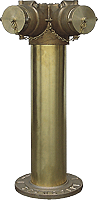
The above picture is of a FDC- Fire Department Connection. A sprinkler valve where the fire fighters plug their hoses into to charge the sprinklers with more water. 
The FDC should be 40 ft off the building and the hydrant should be 100 ft from that.

The Control valve system is there in case someone breaks the sprinkler or something else happens. The fire fighters come to the scene and turn off the valve and replace the sprinkler. 


When buildings are very close together there must be a fire wall. A fire wall is a wall of concrete that prevents a fire from spreading from one building to another. Fire walls are also supposed to extend past the roof line. 

Captain Amos and I also went to the County Building where they hire people for the county.
We met with Geri Onaga who gave me some papers.
One was a formal Maui County Training Announcement for firefighters which explains the duties, the requirements and that there will be a written test and then an agility test.

She also told me about how people apply to become fire fighters. She gave me the form that all Maui County employees fill out which can be found at www.mauicounty.gov/departments/personnel

They also use a website where you can create a candidate profile saying that you are looking for a certain job. https://hi-mauicounty.civicplus.com/jobs.aspx

You sign up for a class online, get a email with a date/time/location and it reminds you two weeks before, one week before and the day before the class.

On Friday I'm going to the Fire Preventions Bureau office to learn more about fire safety.


Friday, November 9, 2012

Annotated Source


Elizabeth Clark

Ms. Fordyce

Senior Project

November 9, 2012

Fire Safety and What it takes to become a fire fighter

Fire Protection Publications. Essentials of Fire Fighting. 5th ed. United States of America: Oklahoma State University, 2008. Print.

This is the annotation of the above source. This text book is used by the recruits that are training to become fire fighters. In this text book it covers a multitude of subjects including: predicted behavior of fires, tools to use and when, rope maintenance- how to tie various knots, personnel safety, moving ground ladder procedures, ventilation, chemicals, construction terminology, water supply and more. The point for this book is to teach the recruits skills, procedures and knowledge they need to know out in the field.

The Essentials of Fire Fighting is a helpful source and recruits use it during training to gain knowledge about the field, certain situations, and skills. This source is 25 chapters long and considering that it is for teaching purposes, I would say that it is not a bias source. I would say that this is a reliable resource because it was published by Fire Protection Publications and the recruits use it first hand to help them beome a fire fighter, they rely on the information to be accurate.

This text book is a useful source for me to use for my research because part of my project is to learn about what it takes to become a fire fighter. What do fire fighters have to know academically? Now that I have this solid source, I have accurate information to add to my research for my project. I feel confident in sharing this with others.

Sunday, November 4, 2012

Station Tour

On Tuesday October 30th a group of kids from Makawao Elementary School went on a field trip to the Kahului Fire Station to hear what the fire fighters had to say about fire safety.

Main Points:

  • Smoke detector begins to beep when there is a fire. 
  • If there is a fire, you should crawl
  • If you are in your room and there is a fire, feel the door with the back of your hand, if it's hot yell out the window for help.
  • The number to call is 911
  • Stop drop and roll

This is all pretty basic stuff.


And then the kids had a competition of who could put the fire fighter suits on first.


Then the kids got to shoot the hose at the props and put out the pretend fire.


And so did I......


Saturday, October 27, 2012

Graduation

Friday October 26th of 2012
Maui Tropical Plantation
Recruit Class 29
Graduates


Congratulations on becoming fire fighters to the 22 recruits! It was a great day at the Tropical Plantation. The Chiefs were there, representatives for Governor Neil Abercrombie and the families of the recruits. Guest speakers spoke about the courage and sacrifice it takes to be a fire fighter and how fire fighters work hard to keep the community safe and they do not go unnoticed. Captain Amos spoke about how it is such a big accomplishment to become firefighters on Maui especially, because they need to go through extra training than those on the mainland and be prepared for any situation from Makai to Mauka and everything in between. Not including all of the tests and evaluations they had to pass.
Watching the video that Kaleo Pua'a put together was really cool. I saw that they all had to work as a team and yes it is physically demanding and no doubt it takes dedication, but it also looked like a lot of fun! 
I enjoyed the pinning ceremony where the recruits' family pinned their badges on their uniforms. 
Misty and I sold a fair amount of shirts during the event to help fund raise. 

Wednesday, October 24, 2012

Monday October 22nd after class I reported to the Kahului Fire Station.

Classroom

I wanted to know about what fire fighters need to know academically and the secretary, Kim, showed me their thick text book and I was able to copy the table of contents.


It's 20 chapters long and covers pretty much everything.. equipment, knot tying, driving, EMR etc...

The fire fighters go through 26 weeks of training and that includes studying.
The first handful of weeks are focused on EMR and then it moved into FADOP which is driving the trucks.
They need to obtain a Commercial Drivers License to drive the trucks.
Then the chapters proceed with other important information.

Guys who work at the airport are hired by the State and guys who become firefighters are hired by the county.

Fire fighters have two different types of gear: Structure gear and wild land gear.
Structure gear is for commercial building fires and wild land gear is for wild fires.

The Kahului Fire Department is #10 and how the departments are numbered are by when they were built. This department was the tenth to be built on the island.
There is no other like it because there are four companies:
Engine company- engines taken to fight fires
Hazmat Company- for hazardous situations (only one in the county)
Tank Company- truck filled with water for wild fires
Rescue Company- used for ocean and mountain rescue (only one in the county)

We took a trip to the Prevention's building to talk to one of the guys that work there and I will be shadowing him for about a day learning about fire codes and fire safety.
Amos and I also dropped off some equipment that was broken and I was able to meet the woman that purchases their equipment.
I will be receiving a PPE request form so I know what kind of equipment is needed for their jobs.

I also want to know what kind of work out routines the guys training to be fire fighters go through to get into shape.

Tomorrow is the graduation for the guys who have been training for the past 26 weeks and I will be attending as well as helping Kim out.

Next week Tuesday I am planning on coming to the fire department before my class because October is fire safety awareness month and different schools will be going to different fire departments to learn about fire safety from the fire fighters. I want to take a video of this presentation and talk to the teachers of the school to set up a time in the spring when I can come for a visit and do a follow up.

Internship has begun

I am now an intern at the Kahului Fire Station on Maui, HI. My mentor is Captain Amos.

Last week Friday October 19th I met Captain Amos of Kahului Fire department at commercial building where they did fire drills. It was very exciting. The fire fighters were divided into three groups: the ones starting the fire, the ones on top of the building poking holes into the roof, and the ones on the fire trucks.


The first three drills the firemen were putting out a house fire. The second three drills the firemen were putting out fires that would take place in commercial buildings for example: Sports Authority.
The groups rotated for each drill.

I learned a lot by just listening to what Amos was telling me and what Kim was saying to the onsite photographers, for what I assume was for the newspaper.
I took notes and pictures.


Fire fighters crawl through this box of wires blind folded with all their gear on, and at the end they have to break through dry wall and they can't cut any of the wires. This is preparation for in case the roof falls and they are crawling through a small space.


Fire fighters need to be familiar with roof construction and different types of roofing. Ex: metal, wood, shingles.


The reason for this is so that if there is a fire they can cut into or poke holes into the roof to let smoke out.


Roofs that are steep require a roof ladder- a ladder that hooks onto the ridge of the top of the roof.


Roofs that aren't as steep don't need assistance. Fire fighters can just stand on it the way it is.


Below you see a picture of a fire truck, this specific fire truck is built to carry these air paks.


The fire room is the room at the end of the hall that they started the fire. Fire moves quickly!  Fire fighters need to back the flames moving towards them with water and save people at the same time. Rooms are dark, large and hard to navigate and if they use too much water it will turn into steam.


On the mainland they have 2-3 guys per company which is dangerously short handed. Could you imagine calling in because your house was on fire and only two firemen show up to put out the fire and to save everyone in the house??

On the mainland they usually get firemen from out of state, however, on Maui we cannot because we are on an island, so that's why it is important for us to have several people on hand.

We are behind though because a lot of instructors are on the mainland and it would cost too much to send them to Hawaii so we send our instructors to the mainland with the money they get for training.


During the drill when they set the fire in the fire room in this particular building they need to cool the metal beams because it can expand with heat.


Fire fighters need to learn how to set up ladders with one person, two person, three persons.
They work with the airport because there are situations when they need to work together as a team for things like rescue.


Fire fighters also need to know some medical information too like CPR, First Aid and how to deliver a baby because there aren't ambulances accessible everywhere.

They also need to know basic hazmat stuff and need to know their chemicals because some fires if you use water to try to put it out it makes things escalate. 

Fire fighters fight fires in commercial buildings, wild fires, do car extractions at the scene of a car accident, ocean and mountain rescue- if someone goes on a hike and gets lost or hurt they go find them.

There are only two women firefighters in Maui County. 


Monday, August 27, 2012

Informative Interview

Monday August 27th
I went to the Wailea Fire Station like I said I would and talked to Lance Yokoyama and Nick Reuss.

What got you interested in this field of work?

Wanting to be able to help people. It's a rare job that gives back to the community. Physicality of the job.

What are the requirements to become a fire fighter? (education provided)

High school diploma.
You have to take a Civil Service exam and if you pass that you move onto the agility test and if you pass that then you go onto an interview to present your resume and start training for about 4-5 months.

What do you think it takes to become a good firefighter?

You have to have personal drive.
You have to want to do your best.
Be open to new things and willing to learn.
Think on your feet and adapt to changing environments and situations.

What's the best skill you've gained from working here?

Dealing with people in a time of crisis. Being calm and in control in a situation that isn't.

What's the living situation at the department/shifts? & What do fire fighters do when they aren't out helping people?

24 hour shifts.
Dorms in the station.
They do home chores and train to help be more efficient.

Other than putting out fires, what do fire fighters respond to?

90% is medical AMP
car accidents
back up for police in certain situations
ocean rescue
mountain rescue
hazmat situations 
flooding, being called to see what we can do.

Tell me about the different causes of fire. How to put it out...

Class A is paper and wood, a combustible  fire.
Class B is liquids and fuels
Class C electrical
Class D special cases
Class K cooking and kitchen

There's a triangle they follow:
Basic fires started by paper or wood you'd put out with the hose.
For liquid fires or fuel fires or ones started in the kitchen you'd smother it with extinguishing foam or baking soda.
Electrical fires you'd need to shut off the power and then treat it as a basic fire.
In those special cases like chemical fires, you use a special chemical extinguisher.
*something to know, magnesium reacts to water, but you can overwhelm the fire with water and it will eventually go out.

Do you have any advice to give to those who are interested in this field?

Stay in school.
If you excel in math and reading you'll get a higher score on the Civil Service Exam. 
Get in shape because you could have all the brains in the world and pass the Civil Service Exam but the physical exam is just as important. 
Now days it's really competitive  and hard to get in because about 2,000 people try for the job and there's only 5-10 openings and you're up against people from out of state too.
So do your best in school.


**Fun fact: I asked why some fire trucks were yellow and some were red, it's because of the contrasting color, visibility.
The only reason the Wailea Fire Station has the red fire truck is because they couldn't afford a yellow one.
Between the red and the yellow there were also bright green trucks as well.


Friday, August 24, 2012

Brainstorming

So for years I've been trying to figure out what I want to do for my Senior Project and the only thing I knew for sure was that I want to help people.
While I was in Elementary school I didn't pay much attention to fire safety so I figured, why not re-learn everything?
I'm planning on going on an informative interview at one of the local fire stations asking fire fighters about fire safety and what it takes to become a fire fighter.
If the interview goes well I can then ask if they are willing to accept high school interns. Hopefully they are!
After my experience at the fire station I can take what I've learned and teach younger kids about it as well.
I was thinking of going to Kamali'i and teaching them about fire safety.
I can also make brochures about what it takes to become a fire fighter for older kids. I could pass them around school, leave them at the front desk, and even post them around the college campus.
I'm feeling confident about my Senior Project.